Thursday, August 21, 2014

The Second Story

I've heard hundreds of accounts of well-known authors whose first novels have never been published.

I figure they wrote that first story because they felt it was just too important not to write, or because the characters kept bothering them, gnawing at them, needing to be put on paper (or the computer screen). Awesome: a new writer is born. But eventually that first manuscript, over which they'd toiled and cried and offered blood sacrifices, was eventually and quietly abandoned. Maybe their idea was too out-there for the current market, the writing wasn't quite up to par, or the structure just didn't work.


And then, they wrote another one. And it was this second story that ended up being the one that launched their careers.

Why does it seem to work this way? I'm beginning to understand.

The first novel I ever wrote on purpose, The Front Range, is done.

The first draft is completely unrecognizable from what it is today (it even has a different title), and while I like it, it was sure a pain in the patooty to get it there. I still don't understand what the hell I was thinking when I wrote some parts of it; some really should-be-dramatic parts were not very dramatic, my characters occasionally acted completely out of character, and some of the language was just plain flat and boring. It's come a long way since then. And now it's "done" (in quotes, because, well, if it's not published, it ain't done). Yay!

So I started another one.

As a new author, I'm almost as intrigued by this whole process of writing as I am by the stories themselves (after all, we write because we have intriguing stories to tell, right?). After I "finished" The Front Range, I started about a half dozen other little WIPs that I got excited about for maybe a day, which usually involved typing a million words per minute into my favorite muse (Notepad). Settings, plots, character profiles - you name it, I wrote it down, and then plunged ahead into the actual story while the fire was still blazing.

And, inevitably, that fire burned out.


So I'd go back into The Front Range, do a little tweaking, a little querying, a little changing, a little sequel-working.

Then I'd get another awesome idea and start the thinking-Notepadding-brainstorming-firestoking process over again, hoping this next one would stick.

And then, one day, one of them did. And it's completely different. The Front Range is a fantasy/adventure, and this new one is a romantic thriller.

no no no, not that kind of thriller

I enjoy thrillers, sure, but honestly, the idea of doing all the necessary research into police procedure, types of weapons, and the intricacies of criminal enterprises never really appealed to me. But for some reason, I couldn't get this idea out of my head. I started writing. Granted, the fire did burn low like I expected it to, but I plunged through the doldrums and came out stronger on the other end.

And MAN is it different. I'm taking risks with style, voice, and flashbacks that I never dreamed of when I wrote The Front Range (the quality of which I still stand by; narrative complexity isn't a prerequisite for a good book, after all). Perhaps the most interesting part is that, because this is a thriller, there are multiple subplots, mysteries, and plot twists I'm planning, and putting them all together in such a way as to keep the reader guessing while providing the proper hints in the proper places is entertaining as hell. It almost feels like the story is a great big fluffy blanket and I'm hiding stuff in its folds, making sure every little hidden item is evenly spaced, adequately concealed, and then revealed in the plot at just the right time so that when you shake the whole thing out, nothing falls and shatters on the floor.

The point is, I've come into it with a better plan this time and, more importantly, with experience.


I must admit part of me is still stubbornly holding onto The Front Range, but I can understand the aforementioned phenomenon a little better now, and I won't be so heartbroken if this story is never published.

I'm still grateful it exists in the first place, for it taught me so much.

It taught me what works for me and what doesn't when it comes to plotting and writing a story.

It taught me how to be comfortable with my writing, helping me find a pattern, language style, and voice that is uniquely me.

(An interesting side note: since I began writing, I've discovered I am better able to communicate orally, with clients and coworkers, almost as if I had unlocked a source of language in my brain that I had never accessed before. I find I am wittier, quicker, and more comprehensible than I was before. Anyone else had this happen?)

And, of course, it taught me the basics of revising, pitching, querying, and publishing. (I still kick myself thinking of all the awesome agents I missed out on simply because I didn't know how to query yet.)

I have high hopes for this second novel. I'm about 16,000 words in and can't wait to finish it, and I already feel like it's a stronger piece than The Front Range.

I'm not saying that, if you're a new author, you should give up on your first piece. By all means, try your damnedest to get it out there; even if it doesn't work out, the process is extremely valuable. But don't let it hold you back, either.

They say that, just like anything else, writing takes practice. Maybe some people get lucky. Maybe some people are naturals.

But many debuts are the second story.

Friday, August 15, 2014

On the Road Again


West Texas.

Miles and miles and miles of road stretching between a handful of tiny towns in the Chihuahuan Desert.


On the busier roads, like US 67 between Alpine and Fort Stockton, maybe you'll pass two dozen other cars on the one-hour drive.

And on the less busy ones, like US 385 from Marathon to Big Bend National Park, you might drive the entire thing and never see a soul.

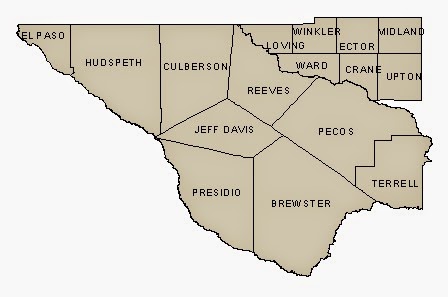
I am the county biologist for the second largest county in Texas, which is larger than the state of Delaware and only slightly smaller than Connecticut. It's almost 100 miles from east to west on I-10, slightly shorter from north to south on the US highways.

central Pecos County

As a member of the District 1 team, I'm often asked to help with my coworkers' tasks too, ranging from El Paso in the west, Midland in the north, Sanderson in the east, and Alpine (where our district office is) in the south. It's a big district; the entire West Texas region is roughly the size of Maine.

Thus, I drive. A lot. We all do.


the road to Alpine

Somewhere in a previous blog post I wrote about how I've begun treasuring these long hours on the road. 

my chariot
There are only a few radio stations, and my truck, with which I have a love/hate relationship, doesn't have a CD player or auxiliary jack and only picks up the radio stations when it feels so inclined. The truck itself is also loud, with shot suspension and doors that don't close properly, so when I do listen to the radio, I have to turn it up so high my ears are often bleeding when I arrive at my destination. 

Thus, most of the time I leave it off, and I drive 75-80 miles per hour (yes, these are the actual speed limits) on the deserted desert roads, sometimes late at night after spotlight surveys, sometimes early in the morning to catch the plane or the helicopter for aerial surveys, and I think about my novels.

There's an actual shift that takes place in my head when I set out, a switch I can almost feel, turning my brain from real life to imagination. Sometimes my real-life worries are too great or I'm too tired, and it's frustrating then, like I can't quite reach that switch no matter how hard I try. But when I can reach it, it's magic.

Yucca, ocatillo, rattlesnakes, and mesquite fly by, and maybe another car or two (to which my fingers automatically lift from the steering wheel to offer a friendly salute, like the fingers of all good West Texans), and I barely notice. I'm thinking about my scenes. I'm thinking about that awkward moment when my two main characters meet, the build-up of romantic tension as they travel through Europe, that climactic moment when they first kiss. I'm thinking of enemies, attacks, close calls, and tragic ends. I'm thinking of witty remarks to impertinent questions, lies told to mask emotion, declarations of love and loyalty that are neither cheesy nor understated. Winks, nods, shrugs, frowns. Plot twists, hidden agendas, secret ambitions, driving forces. I put it all together.

I even keep a little notebook in my center console so I can jot particularly good ideas down. Not while driving, of course. Sure, there's never any traffic, but you never know what might jump out in front of you on these roads, like a deer or an aoudad...


...or something else.

black-tailed rattlesnake in Pecos County

I feel lucky that I get to have these moments, these hours of faraway thought, this valuable time for imagining and plotting and fine-tuning. As someone who's sort of ADHD, I have a hard time sitting still at home trying to come up with ideas. I can't even do it while hiking, one of my favorite things to do, because I'm so stimulated by everything around me.

Driving is it. Driving is key. Driving is crucial. I'm not sure why.

I have always loved driving, probably for this very reason. Sure, I'm useless in places of unending beauty (and road-happy wildlife) like Colorado or Montana, or places with heavy traffic, or places I've never been, but I now know the roads of West Texas so well, each twist and turn, each blind corner, each patch of cedars where I know the elk are lurking, that I can do it on autopilot. Don't get me wrong - I'm still aware of what's happening. I can still spot the eyeshine of a deer coming up on the shoulder and press my foot to the brake, or watch an approaching oil truck to make sure he stays in his lane. I have damn good driving instincts and I'm not ashamed to brag. Maybe this is why I love it - because I can do two things at once, a perfect, guilt-free combination of work and pleasure.

Maybe I love it because it keeps me sane. Because I'd go nuts with all this driving if my brain didn't have a way to amuse itself.

Maybe I love to drive because I'm a writer.

Maybe I'm a writer because I love to drive.

my personal car in Glacier National Park

Thursday, August 14, 2014

I suppose I should write something new?

Alas, I have not a thing to write about today.

Except #PitchWars is going on, and I've already submitted, and no matter how much I try to stay away from the Twitter feed, it beckons like a siren - like the Starbucks siren - until resistance is futile.

Oooh. I'm going to go get some coffee.

Friday, August 1, 2014

#MyWritingProcess Blog Hop

Time for my round in the Blog Hop! I've never done one of these before (though I used to do art memes all the time; I forgot how much fun these things are!).

I was tagged by Tracie Martin, who can be found blogging here and tweeting here. I met her recently through a Twitter contest and can't wait to read her stuff; from what I've seen on her blog and in personal communication, she's a pretty damned good writer.

OK, without further ado...

1. What I'm working on
I've got a novel I've been querying out to agents called The Front Range, but it's beginning to feel like an albatross, in all honesty. It's an adult fantasy/adventure about a biologist, a hidden world, and a mythical spirit that exists in Nature but has been forgotten by pretty much everyone. I may never get it published but it's been a joy to write and has, hopefully, made me a better writer.
one of my TLK fanarts

I also have started three other WIPs that are much different (more contemporary). I tend to like writing Adult fiction rather than YA or MG, though I've toyed with the idea of  making a picture book since I love to draw wildlife (especially cartoony wildlife).

2. How does my work differ from others in the genre?
I'm really not sure I know how to answer this question, partly because I'm not sure what my genre is (at least for The Front Range). In general, I feel like there's not as much just plain Adventure writing out there for adults anymore - it all has to be either contemporary, or fantasy, or science fiction, or romance - but I like all of these things rolled up into one, and that's what I tried to do. The novel is very much based on real life, with real-life characters, real-life settings, and real-life problems, but with a secret, grand, almost fantastic mythology rooted in old legends and theologies.

Maybe another thing that's different is that I like to incorporate my own life experiences, which, in my case, might be considered unique. I'm a scientist (wildlife biology as well as genetics) with a passion for wildlife conservation, and I want to instill a love for animals and the outdoors in my readers. One of my current WIPs stars a girl (like me) who's a nerdy geneticist (like me), and while genetics ends up playing a minor role in the plot, I love the chances I have to take something as complicated as DNA and PCRs and make it interesting for laymen (without losing them in the process - it's a fine line, and a great challenge).

3. Why do I write what I do?
a little non-TLK art
Like I said, I've got a passion for wildlife/wilderness. When I was little I was always writing stories about talking animals (usually either wolves or, after 1994, The Lion King fan-fiction). I drew (and still draw) wildlife all the time. Watership Down is one of my favorite books of all time; unfortunately talking-animal stories aren't really marketable anymore, or so I'm led to believe, at least not for adults.

me with a bat I caught in TX
However, I ended up becoming a wildlife biologist, and I've come to believe that the human dimension is often the most interesting facet of conservation - the conflicts between predators and ranchers (I have worked with both), the problem of exurban development into wildlife habitat, etc. It's still amazing to me how clueless people often are to these very real problems. My greatest fear is that I'll wake up one morning to a world where the animals and wildernesses I love no longer exist and it's all because people just have no idea this is going on. I think that drive to instill an appreciation for our natural world is what inspired The Front Range.

For my other WIPs, that inspiration is still there, but to a lesser degree. A side effect of writing the Front Range was learning that I like to write characters (usually NA-aged) who learn and grow from adversity in life, or who think they're happy living in a sheltered bubble only to discover things are so much more interesting on the outside. I've had many experiences to help me with this!

4. How does my writing process work?
It started off with me taking a cute little notebook to Starbucks on my time off (I was working at a different Starbucks at the time) and just writing things down for hours. Then I built a vague outline on my laptop and started writing (still at Starbucks).

arg this makes me want a latte every time I look at it
Things are a little more structured now, I guess. Instead of a notebook I prefer Notebook - I can type really quickly and for some reason, the simplicity of Notebook is just perfect for brainstorming. Then I may or may not come up with an outline, but more often than not I just write down the main plot points so I don't forget them, and start writing in Microsoft Word.

I do have a full-time job as a wildlife biologist, so it really limits how much time I have to write. I hate my current situation right now - I love writing in coffee shops and there AREN'T ANY where I live. So I basically just sit down in my chair and write whenever I feel like it, mostly on weekend mornings when I can do it right when I wake up.

A few little things, though:
-I write things as I feel like it, not necessarily in order. I wrote the climax of the Front Range's sequel when I was only 1/3 or so done with it because I just couldn't get it out of my head.
-I can't listen to music when I write. I love music, but I pay too much attention to it to be able to write simultaneously.
-I don't revise very systematically. I should probably change this.
-I like to spend a lot of time driving/walking so I can daydream my books and flesh things out in my head.

And now it's someone else's turn!

I am tagging Eva Gibson! Her blog at http://mamamuzzle.com is frickin' hilarious and makes me both want and not want kids at the same time. She tweets at https://twitter.com/EvaVBGibson.

I also tag Carl Hackman, who blogs at http://www.carlhackman.com and tweets at https://twitter.com/CarlHackman. He's a fantasy writer, SCBWI member, and woodturner (check his blog to find out about that!).


Tuesday, July 15, 2014

West Texas Vocab

As someone who's moved from place to place almost more times than I can count, I'm always on the lookout for regional slang/dialect. I thought I'd share some of the new vocabulary words I've learned now that I've been in West Texas for a year.

Ditch chicken. This one made me laugh uncontrollably. Picture below. You might know it as a ring-necked pheasant in more normal parts of the country.


Speedgoat. Pronghorn. It's not a goat (or an antelope) but it's pretty dang fast - the fastest land mammal in North America, able to reach speeds of up to 55 mph.

Three pronghorn does. Photo taken from a plane during 2014 pronghorn surveys

Norther. Cold front. They always come from the north.

Bull bat. Common nighthawk, a bird in the order Caprimulgiformes that comes out in the evenings, has weird gangly wings that make a funny sound when the bird dive-bombs bugs, and is nearly impossible not to hit when driving down the highway at night.


Turdfloater. Heavy rain, heavy enough to pool in the roads and pastures and, well, move the cow turds around.

Vinegaroon. This horrifying creature:

not my photo, not my man-hands

...which is apparently some kind of arachnid related to scorpions. Also known as whipscorpions, vinegaroons are not venomous, fortunately (though they're still horrifying and I hope I never actually see one).

Summer. March - November.

Breeze. Any wind speed less than 30 mph.

Hurricane. Glorious, wonderful source of rain. Wait, they're bad for some people?

That's it for now. Pop quiz tomorrow.

Wednesday, July 9, 2014

Rejection - Your Most Dangerous Villain


It's been a rough couple of days. Not only did I find out I wasn't selected for an interview for a dream wildlife biology job in Washington...


wrong Washington, though the pic seemed appropriate
...but I also received two rejections from agents I queried.


I still can't figure out why Washington doesn't want me, since I feel like I'm a pretty objectively good wildlife biologist. As for the agent thing, though, anyone will tell you that getting lots of rejection is pretty standard.

But it's still hard.

And the worst part is it makes me not excited about writing anymore. Every time.

I've had quite a few sleepless nights thinking about those writers who struck it big with best-selling debut titles and movie deals and all that jazz. I think that, to date, these moments have been my biggest battles with Envy - especially when the authors were young, just plain lucky, and/or wrote books that I didn't find particularly good. Dammit, my book is good. Why doesn't anyone want it?

At the moment, I don't feel much like writing. My characters are beckoning, my unfinished scenes are playing out in a neverending filmstrip in my mind with all the possible permutations and twists and turns and dialogue, and will continue to do so until I write them down.

But I don't feel like it.

The problem with this is the logic. I started writing not because I wanted to sell a book. I started writing because I loved it.

I've been doing it since I was 5, took a break in high school, and finally returned to it at age 28. I've sat for hours with my eyes glued to the computer screen, goosebumps on my arms, because I love where my story is going or just finished writing a particularly exciting/moving/compelling scene. (This is a big thing for me - I have a hard time sitting still for any extended period of time. For any other reason.) I've experienced the joy of feeling like the book is writing itself, like when I come across a potential plot hole, and realize I unwittingly solved it months ago with a scene to which, at the time, I didn't give much thought. I treasure the hours and hours of driving I have to do for my job, because I get to get paid for sitting and thinking about my novel. I thought up some of my best stuff on these drives.

And I'm so glad the timing has worked out the way it has. If I didn't have writing, I'm convinced I'd go insane in this tiny town where the only things to do are meth and bowling.


Anyway, the point of this post is that, sometimes, I have to remind myself of this. It's easy to get discouraged when all you're getting are rejections (or even if you do get the occasional request for the full MS). It's easy to forget why I started doing this in the first place.

Sometimes, you just need to back away for a while. Publishing is not the means to an end. It's an end, and should be the least enjoyable part of the process - a process that we voluntarily began, because we love it. We must not forget that.

We're writers. Writers write. We write because we can't not.

Thursday, July 3, 2014

Everything Here Wants To Kill Me

Welcome to the desert.

I live in West Texas, in a town I like to call the Worst Place in America. I won't name names. Really, though, there aren't a whole lot of towns out here, so you can probably guess.

It was hard to move here, I'll admit. I lived in a crappy hotel for a week before I found my apartment, a place where dead cockroaches and the stale scent of old carpet greeted me when I walked in, and the door doesn't fit on the hinge properly and lets all manner of creepy-crawlies invade. But there was nowhere else to go. The booming oil and gas industry claimed all the housing (and then made it so I pay twice what I should in rent).

Plastic bags and other trash clings to everything and flutters when the wind blows (which is all the time). The number of gas stations per capita is absurdly high because my town is the only thing on the Interstate for miles and miles in either direction. The sound of the tractor-trailers roars all day long. As for a social scene for 20-somethings, or the prospect of meeting the Man of My Dreams, well, neither of those things exist.

As they like to say of Alaska, the odds are good but the goods are odd. 

Why didn't I just hop back into my moving van and drive straight back to Austin, you ask? Well, because all that was waiting for me there was my old job as a barista at Starbucks, making minimum wage (with a Master's degree under my belt, I might add).

I came here for my career. I promised myself I'd stay a year.

And now I have. (Which, incidentally, makes it the longest I've stayed at the same job if you don't count graduate school, which took 23 months.)

I made sacrifices, sure. I got used to things I thought I'd never get used to.

Big Bend National Park
  I used to think I had to live near water; now I no longer shake my fist in anger when the storm that's been building on the horizon all day, growing ever closer hour by hour and wafting the scent of rain and the sound of thunder into town, magically disappears on the edge as if repelled by the Worst Place in the World-ness of this city. Even God doesn't want to touch this place, I always think, with bitterness. But I've gotten used to it.

I got used to the cockroaches. I cut a water bottle in half and keep it on the table to scoop up the dead ones in the summer. I plug the sinks at night. I can't stand the crunch when I squish the live ones, so I've perfected my aim for throwing heavy things at them.

I got used to the spider living under my pantry. He might be highly venomous; I have no idea. He eats flies and mosquitoes and for that I'm grateful. I even wrote a story about him (or her).

I got used to the way everything out here wants to kill me. To pulling mesquite and goatshead thorns out of my foam sandals every thirty seconds. To watching the ground before my feet when I jog so I don't step on a rattlesnake. To becoming crepuscular in my outdoor habits so the summer heat doesn't scald me. And for watching my back when I'm near the border.

I even got used to the seclusion. I got used to spending all my free time watching Netflix, writing, and playing my guitar. I got in touch with my inner introvert, channeling all the bitterness and self-loathing I fear from loneliness into my fingers, and purging all of it in my rare moments of socialization with coworkers, so that they never even suspect it.

I got used to the desert.

Funny thing is, I grew up in it: Mesa, Arizona, suburb of Phoenix, in the middle of the Sonoran Desert with its endemic saguaro cacti. I never remembered hating it. Why would I? I had nothing to compare it to. It was only when I went off to college in the Northwest, and worked jobs in Colorado and Yellowstone and later the Ozark hills of Missouri, that I realized what I was missing.

Rain. Snow. Creeks. Trees. Shade.

I vowed I could never again live without them. Like Tolkien's lost Elves who have never seen the sea, but feel it in their blood, the forest was in mine. It always had been. And once I saw it, I knew I could never go back. It was a cruel fate that found me hopping from job to job for the next twelve years, only to land right back in the ecosystem I had vowed never to return to, with its heat and thorns and fangs and venom.


And the funny thing is, I kind of like it. Took me a year to realize it.

I may have traded Sonora for Chihuahua, saguaro for lechugilla, but it's much the same. There's something magical about a place that's so hostile that everything in it will kill to protect its niche, the niche it worked so hard to find. There's something magical about the way the red rocks glow after the sun sets, and every living creature awakens and moves where before you would swear there was nothing. There's magic in the smell of the rain because it is so scarce, magic that no one who has not suffered through drought could ever appreciate.

All the pictures on this blog post were taken by me, on and off the job right here in the Trans-Pecos. Once you get past the dryness, the heat, and the cockroaches, it's a pretty amazing place.

Maybe the desert is in my blood, too.